
A research team led by Feng Liu, Associate Professor (tenured) at the College of Information Science and Electronic Engineering, Zhejiang University, has demonstrated a new method for generating entangled photon pairs from semiconductor quantum dots, achieving a biexciton population of 96.6% and a polarization entanglement fidelity of 93.4%. The results, obtained with partners in Germany, were published in Nature Communications.
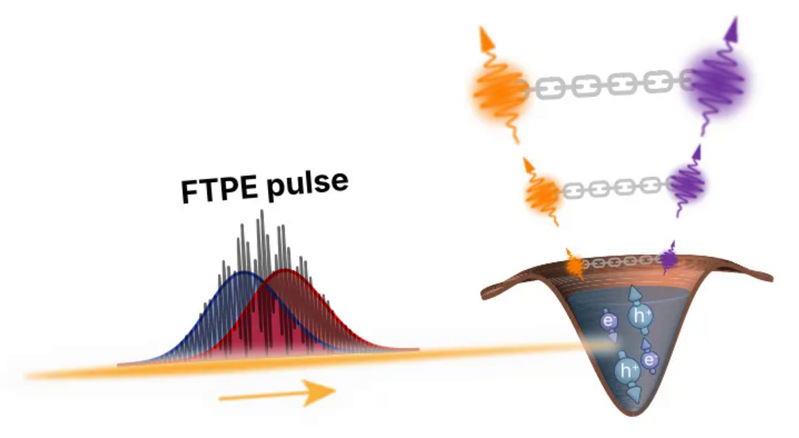
Entangled photon pairs are a key resource for quantum communication, photonic quantum computing, and quantum sensing. Semiconductor quantum dots are attractive because they can generate such pairs on demand through a process called biexciton–exciton cascaded emission. The first step is to prepare the biexciton state efficiently and reliably.
Conventional two-photon excitation can prepare biexcitons with low decoherence, but the result is sensitive to laser power and to variations between individual quantum dots. It also requires the laser frequency to sit between two emission lines, which makes spectral filtering difficult and limits scalability for dots with small or negative biexciton binding energies.
Liu’s team proposed and experimentally validated a scheme called Floquet-engineered two-photon excitation (FTPE). Rather than tuning a single laser to the two-photon resonance, FTPE uses two symmetrically detuned pulses whose combined energy matches the biexciton energy. The overlapping pulses drive the quantum dot through a single Floquet evolution. The scheme does not require precise control of the optical phase between the two pulses, and the larger spectral separation from the emission lines relaxes the filtering requirements.
The team also showed that the scheme works by effectively suppressing the intermediate exciton state under sufficiently large detuning, and that introducing a finite pulse delay compensates for small deviations in drive strength, broadening the window for efficient biexciton preparation.
The work points toward more robust, on-demand solid-state entangled photon sources for scalable quantum technologies. The study, titled “Robust biexciton preparation for entangled photon-pair generation by single-shot Floquet driving,” was a joint effort involving four universities in China and Germany.
DOI:https://doi.org/10.1038/s41467-026-77221-9
